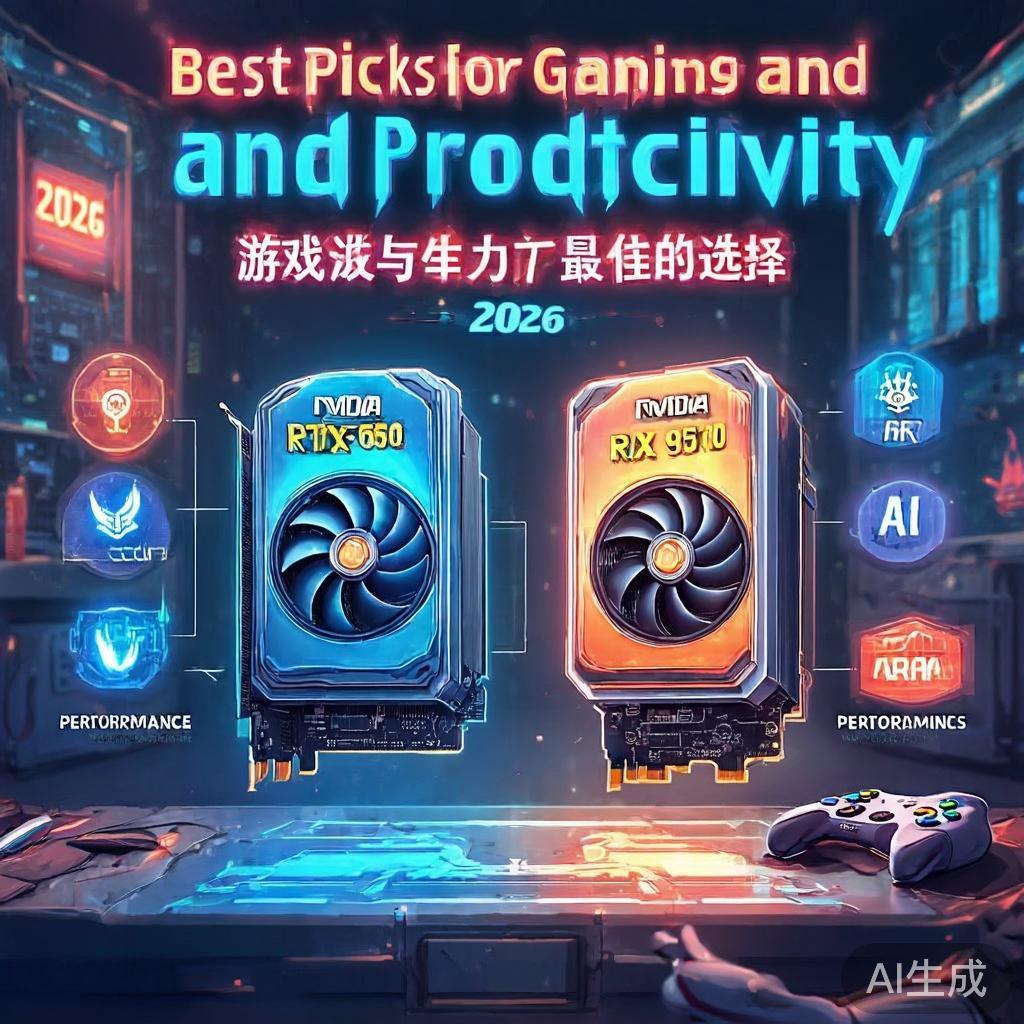
2026主流显卡横评:RTX 5060 vs RX 9060 vs RTX 5070——游戏与生产力最佳选择 2026 Mainstream GPU Roundup: RTX 5060 vs RX 9060 vs RTX 5070 — Best Picks for Gaming and Productivity
 广告招租
广告招租 2026主流显卡横评:RTX 5060 vs RX 9060 vs RTX 5070——游戏与生产力最佳选择
2026 Mainstream GPU Roundup: RTX 5060 vs RX 9060 vs RTX 5070 — Best Picks for Gaming and Productivity
2026年的显卡市场正处于一个有趣的分水岭。NVIDIA凭借Blackwell架构和DLSS 4多帧生成技术继续领跑,而AMD则用RDNA 4架构和AI驱动的FSR 4发起反击。对于大多数消费者来说,RTX 5060、RX 9060和RTX 5070这三款显卡构成了最核心的选择区间——覆盖了从1080p入门到1440p高刷再到轻度AI创作的全部需求。
本文将从性能、价格、显存、AI特性和能效五个维度,为你详细解析这三款显卡的优劣,并给出针对不同使用场景的最终购买建议。
The GPU market in 2026 finds itself at an interesting crossroads. NVIDIA continues to lead with its Blackwell architecture and DLSS 4 Multi Frame Generation, while AMD fights back with RDNA 4 and AI-driven FSR 4. For most consumers, the RTX 5060, RX 9060, and RTX 5070 form the core selection range — covering everything from entry-level 1080p gaming to high-refresh 1440p and even light AI creation.
This article breaks down these three GPUs across five key dimensions: performance, price, VRAM, AI features, and efficiency — and provides final purchase recommendations for every use case.
购买背景:2026年显卡市场三大趋势
Buying Context: Three Key Trends in the 2026 GPU Market
在进入具体产品对比之前,有必要了解2026年显卡市场的三个核心变化:
1. 架构换代:Blackwell vs RDNA 4 NVIDIA的RTX 50系列基于Blackwell架构,AMD的RX 9000系列则采用RDNA 4架构。两代架构的共同点是:不再追求极致的纯光栅性能提升,而是将重心转向AI加速和能效优化。这意味着,即使你不玩支持DLSS或FSR的游戏,新显卡带来的功耗降低和散热改进也是实实在在的。
2. AI功能大战:DLSS 4多帧生成 vs FSR 4 AI升级 2026年,显卡的”AI功能”已经成为比纯帧率更重要的购买指标。NVIDIA的DLSS 4引入了多帧生成技术(Multi Frame Generation),每渲染一帧可生成最多三帧,在支持的游戏里帧数翻倍甚至更多。AMD的FSR 4终于放弃了传统的空间放大算法,转向AI模型驱动,画质提升显著,但距离DLSS 4的稳定性和细节还原仍有差距。
3. 能效优先:小机箱友好时代 RTX 5060的功耗约150W,RX 9060约170W,RTX 5070约220W。相比上一代,能耗比提升明显。这意味着550W电源即可驱动RTX 5060,650W电源就能应对RTX 5070。对于ITX小机箱玩家来说,这是好消息。
Before diving into specific products, it’s important to understand three major shifts in the 2026 GPU market:
1. Architecture Transition: Blackwell vs RDNA 4 NVIDIA’s RTX 50 series is built on Blackwell, while AMD’s RX 9000 series uses RDNA 4. The common theme: neither camp is chasing raw rasterization gains; instead, the focus is on AI acceleration and power efficiency. Even if you don’t play games that support DLSS or FSR, the reduced power draw and improved cooling are tangible benefits.
2. The AI Feature War: DLSS 4 Multi Frame Gen vs FSR 4 In 2026, “AI features” have become a more important buying criterion than raw frame rates. NVIDIA’s DLSS 4 introduces Multi Frame Generation, generating up to three frames for every rendered frame, effectively doubling or more the frame rate in supported titles. AMD’s FSR 4 has finally abandoned traditional spatial upscaling for an AI-driven model, delivering significantly improved image quality — though it still lags behind DLSS 4 in stability and detail preservation.
3. Efficiency First: The Era of Small-Form-Factor Friendly GPUs The RTX 5060 draws about 150W, the RX 9060 around 170W, and the RTX 5070 approximately 220W. Compared to the previous generation, performance-per-watt has improved dramatically. A 550W PSU is enough for the RTX 5060, and a 650W unit will comfortably handle the RTX 5070. Great news for ITX builders.
关键购买标准:如何选择适合你的显卡
Key Buying Criteria: How to Choose the Right GPU
在对比具体型号之前,先明确四个决定因素:
Before comparing specific models, let’s clarify four decisive factors:
1. 目标分辨率与帧率
1. Target Resolution and Frame Rate
- 1080p高刷(144Hz+): RTX 5060是性价比之王,DLSS 4加持下轻松跑满。
- 1440p高刷(144Hz+): RTX 5070是首选,RX 9060在非光追游戏中也能胜任。
- 4K入门: 只有RTX 5070能勉强胜任,RX 9060和RTX 5060更适合降分辨率玩。
- 1080p high-refresh (144Hz+): The RTX 5060 is the value king, easily maxing out with DLSS 4.
- 1440p high-refresh (144Hz+): The RTX 5070 is the top pick; the RX 9060 also handles non-ray-traced titles well.
- 4K entry-level: Only the RTX 5070 can barely manage; the RX 9060 and RTX 5060 are better suited for lower resolutions.
2. 显存容量:8GB vs 12GB vs 16GB
2. VRAM Capacity: 8GB vs 12GB vs 16GB
这是2026年最敏感的购买话题。RTX 5060搭载8GB GDDR7显存,对于1080p游戏完全足够,但如果你玩《黑神话:悟空》或《赛博朋克2077》这类纹理密集型游戏并开启高画质,8GB可能在1440p下成为瓶颈。RX 9060提供12GB或16GB版本,显存优势非常明显,尤其适合纹理包玩家和本地AI模型运行。
This is the most sensitive buying topic in 2026. The RTX 5060 comes with 8GB of GDDR7 VRAM — perfectly adequate for 1080p gaming. But if you play texture-heavy titles like Black Myth: Wukong or Cyberpunk 2077 at high settings, 8GB may become a bottleneck at 1440p. The RX 9060 offers 12GB or 16GB options, giving it a clear VRAM advantage, especially for texture pack enthusiasts and local AI model inference.
3. AI升级质量:DLSS 4 vs FSR 4
3. AI Upscaling Quality: DLSS 4 vs FSR 4
DLSS 4多帧生成在支持的游戏中(目前约40+款)效果惊人,帧率提升可达2-3倍,画质损失极小。FSR 4虽然进步巨大,但在快速移动场景和细碎物体(如树叶、网格)上仍有闪烁和模糊问题。如果你对画质敏感且预算充足,DLSS 4是加分项。如果预算有限且以单机游戏为主,FSR 4的性价比更高。
DLSS 4 Multi Frame Generation delivers stunning results in supported titles (currently 40+ games), boosting frame rates by 2-3x with minimal quality loss. FSR 4 has improved dramatically, but it still exhibits flickering and blur in fast-moving scenes and fine details (foliage, fences). If you’re sensitive to image quality and have the budget, DLSS 4 is a plus. If you’re on a tighter budget and play mostly single-player games, FSR 4 offers better value.
4. PCIe 5.0支持与电源需求
4. PCIe 5.0 Support and Power Requirements
三款显卡均支持PCIe 5.0。目前PCIe 5.0对游戏性能影响不大,但未来DirectStorage游戏可能受益。电源方面:RTX 5060建议550W,RX 9060建议600W,RTX 5070建议650W。
All three GPUs support PCIe 5.0. Currently, PCIe 5.0 has minimal impact on gaming performance, but future DirectStorage titles may benefit. Power recommendations: RTX 5060 — 550W, RX 9060 — 600W, RTX 5070 — 650W.
产品深度对比:规格、价格与性能
Product Deep Dive: Specs, Pricing, and Performance
NVIDIA GeForce RTX 5070NVIDIA GeForce RTX 5070
规格:Specs: 12GB GDDR7,DLSS 4多帧生成,PCIe 5.0,功耗约220W12GB GDDR7, DLSS 4 Multi Frame Gen, PCIe 5.0, ~220W TDP
价格:Price: 约 ¥4,400 起Starting at around $549
RTX 5070是1440p游戏的绝对王者。在DLSS 4多帧生成的加持下,它在《赛博朋克2077》中可达120fps+,在《使命召唤:黑色行动6》中可达144fps+。光追性能在同价位无人能敌。12GB显存对于1440p足够,但如果未来4K纹理越来越普遍,可能会成为瓶颈。适合追求极致画质和帧率的玩家。The RTX 5070 is the undisputed king of 1440p gaming. With DLSS 4 Multi Frame Gen, it delivers 120fps+ in Cyberpunk 2077 and 144fps+ in Call of Duty: Black Ops 6. Ray tracing performance is unmatched at this price point. 12GB VRAM is sufficient for 1440p, but could become a bottleneck if 4K textures become more common. Ideal for enthusiasts who demand the best visual quality and frame rates.
NVIDIA GeForce RTX 5060NVIDIA GeForce RTX 5060
规格:Specs: 8GB GDDR7,DLSS 4单帧生成,PCIe 5.0,功耗约150W8GB GDDR7, DLSS 4 Single Frame Gen, PCIe 5.0, ~150W TDP
价格:Price: 约 ¥2,600 起Starting at around $329
RTX 5060是1080p游戏的性价比标杆。DLSS 4单帧生成在1080p下表现稳定,光追性能也远超同价位AMD产品。但8GB显存是硬伤——如果你打算用1440p显示器,或者喜欢打纹理Mod,建议跳过这款直接上RX 9060。适合预算有限、长期使用1080p显示器的玩家。The RTX 5060 is the value champion for 1080p gaming. DLSS 4 Single Frame Gen performs well at 1080p, and ray tracing is far ahead of AMD offerings at this price. However, 8GB VRAM is a limitation — if you plan to use a 1440p monitor or enjoy texture mods, skip this and go for the RX 9060. Best for budget-conscious gamers sticking with 1080p long-term.
AMD Radeon RX 9060 12GB / 16GBAMD Radeon RX 9060 12GB / 16GB
规格:Specs: 12GB/16GB GDDR6,FSR 4 AI升级,PCIe 5.0,功耗约170W/185W12GB/16GB GDDR6, FSR 4 AI Upscaling, PCIe 5.0, ~170W/185W TDP
价格:Price: 12GB版约 ¥2,400 起,16GB版约 ¥2,800 起12GB from ~$299, 16GB from ~$349
RX 9060是AMD在2026年的反击之作。12GB版本直接对标RTX 5060,价格更低、显存更大;16GB版本则瞄准了轻度AI创作者和1440p游戏玩家。FSR 4的AI升级效果虽然不如DLSS 4,但在大多数游戏中已经非常可用。光追性能仍然落后NVIDIA,但传统光栅性能与RTX 5060打平甚至略优。如果你看重显存和性价比,RX 9060是首选。The RX 9060 is AMD's counterpunch in 2026. The 12GB version directly targets the RTX 5060 with lower pricing and more VRAM; the 16GB version appeals to light AI creators and 1440p gamers. FSR 4's AI upscaling isn't as polished as DLSS 4, but it's very usable in most titles. Ray tracing still lags behind NVIDIA, but raw rasterization performance matches or slightly exceeds the RTX 5060. If VRAM and value are your priorities, the RX 9060 is the clear winner.
规格对比表
Specs Comparison Table
| 规格Spec | RTX 5070 | RTX 5060 | RX 9060 12GB | RX 9060 16GB |
|---|---|---|---|---|
| 架构Architecture | Blackwell | Blackwell | RDNA 4 | RDNA 4 |
| 显存VRAM | 12GB GDDR7 | 8GB GDDR7 | 12GB GDDR6 | 16GB GDDR6 |
| 显存位宽Memory Bus | 192-bit | 128-bit | 192-bit | 192-bit |
| AI升级AI Upscaling | DLSS 4 多帧生成 | DLSS 4 单帧生成 | FSR 4 | FSR 4 |
| 功耗 (TDP)Power (TDP) | ~220W | ~150W | ~170W | ~185W |
| 建议电源Recommended PSU | 650W | 550W | 600W | 600W |
| PCIe | 5.0 x16 | 5.0 x16 | 5.0 x16 | 5.0 x16 |
| 起售价 (约)Starting Price (approx.) | $549 / ¥4,400 | $329 / ¥2,600 | $299 / ¥2,400 | $349 / ¥2,800 |
优缺点速览
Pros & Cons at a Glance
RTX 5070 优点RTX 5070 Pros
- DLSS 4多帧生成效果惊艳Excellent DLSS 4 Multi Frame Gen
- 光追性能同价位最强Best-in-class ray tracing at this price
- 1440p高刷完美体验Perfect for high-refresh 1440p
RTX 5070 缺点RTX 5070 Cons
- 价格偏高Higher price point
- 12GB显存对4K可能不够12GB VRAM may not be enough for 4K
RTX 5060 优点RTX 5060 Pros
- 1080p性价比极高Excellent 1080p value
- 功耗低,适合小机箱Low power draw, SFF-friendly
- DLSS 4单帧生成稳定Stable DLSS 4 Single Frame Gen
RTX 5060 缺点RTX 5060 Cons
- 8GB显存是硬伤8GB VRAM is a major limitation
- 1440p游戏体验受限Limited 1440p gaming experience
RX 9060 优点RX 9060 Pros
- 显存大,12GB/16GB可选Large VRAM options (12GB/16GB)
- 价格实惠,性价比高Affordable, great value
- FSR 4进步显著Significant FSR 4 improvements
RX 9060 缺点RX 9060 Cons
- 光追性能落后NVIDIARay tracing lags behind NVIDIA
- FSR 4画质不如DLSS 4稳定FSR 4 image quality less stable than DLSS 4
最终推荐:根据你的使用场景选择
Final Verdict: Recommendations by Use Case
| 使用场景Use Case | 推荐显卡Recommended GPU | 理由Why |
|---|---|---|
| 纯1080p游戏Pure 1080p Gaming | RTX 5060 | 性价比最高,DLSS 4提升明显Best value, strong DLSS 4 uplift |
| 1440p高画质游戏(重光追)1440p High-Quality Gaming (RT-heavy) | RTX 5070 | DLSS 4多帧生成+光追无敌Unbeatable DLSS 4 + ray tracing combo |
| 1440p游戏(重显存/性价比)1440p Gaming (VRAM/Value Focus) | RX 9060 12GB | 显存大、价格低,FSR 4够用More VRAM, lower price, FSR 4 is good enough |
| 轻度AI/生产力Light AI / Productivity | RX 9060 16GB | 16GB显存适合本地模型运行16GB VRAM ideal for local model inference |
| 预算有限但想战未来Budget-Conscious, Future-Proof | RX 9060 12GB | 最低价格获得12GB显存和FSR 4Lowest price for 12GB VRAM + FSR 4 |
常见问题 FAQ
Frequently Asked Questions
问:RTX 5060的8GB显存够用吗?
Q: Is 8GB VRAM on the RTX 5060 enough?
答: 对于1080p游戏,8GB完全足够。但如果你计划使用1440p显示器,或者喜欢安装高分辨率纹理Mod,建议至少选择12GB显存的显卡。在2026年,8GB对于1440p已经捉襟见肘。
A: For 1080p gaming, 8GB is perfectly adequate. But if you plan to use a 1440p monitor or enjoy installing high-resolution texture mods, we recommend at least 12GB of VRAM. In 2026, 8GB is starting to feel tight for 1440p.
问:FSR 4和DLSS 4哪个画质更好?
Q: Which has better image quality — FSR 4 or DLSS 4?
答: DLSS 4在画质稳定性、细节还原和抗锯齿方面明显优于FSR 4。FSR 4进步巨大,但在快速移动场景和细碎物体上仍有闪烁和模糊。不过,FSR 4是开源且免费的,而DLSS 4需要游戏厂商适配。如果你对画质极其敏感,选NVIDIA;如果预算优先,FSR 4完全可用。
A: DLSS 4 is clearly superior in terms of image stability, detail preservation, and anti-aliasing. FSR 4 has made huge strides, but it still exhibits flickering and blur in fast-moving scenes and fine details. That said, FSR 4 is open-source and free, while DLSS 4 requires developer implementation. If you’re extremely sensitive to image quality, go with NVIDIA. If budget is the priority, FSR 4 is perfectly usable.
问:我需要PCIe 5.0支持吗?
Q: Do I need PCIe 5.0 support?
答: 目前PCIe 5.0对游戏性能影响很小,甚至PCIe 4.0的RTX 5060和RX 9060在大多数游戏中性能损失不到3%。但如果你计划在未来2-3年内升级DirectStorage游戏,PCIe 5.0可能会带来加载速度优势。三款显卡都支持PCIe 5.0,但如果你用的是老平台(如B550或Z690),PCIe 4.0也完全够用。
A: Currently, PCIe 5.0 has minimal impact on gaming performance — even PCIe 4.0 results in less than 3% performance loss for the RTX 5060 and RX 9060 in most titles. However, if you plan to upgrade to DirectStorage games in the next 2-3 years, PCIe 5.0 may offer faster loading times. All three GPUs support PCIe 5.0, but if you’re on an older platform (e.g., B550 or Z690), PCIe 4.0 is perfectly fine.
总结:2026年的主流显卡选择不再只是"谁跑得更快",而是"谁的功能更适合你"。RTX 5070是1440p游戏的终极选择,DLSS 4多帧生成无人能敌;RTX 5060是1080p性价比之王,但8GB显存需要谨慎;RX 9060以更大的显存和更低的价格成为性价比黑马,尤其适合轻度AI创作者和预算有限的玩家。根据你的实际使用场景和预算做选择,三款显卡都没有"错"的答案,只有"更适合"的答案。
Bottom Line: Choosing a mainstream GPU in 2026 is no longer about "which one is faster" — it's about "which one fits your needs better." The RTX 5070 is the ultimate 1440p gaming card, with unbeatable DLSS 4 Multi Frame Gen. The RTX 5060 is the 1080p value king, but its 8GB VRAM requires caution. The RX 9060 emerges as a value dark horse with more VRAM and lower pricing, especially appealing to light AI creators and budget-conscious gamers. Choose based on your actual use case and budget — there's no "wrong" answer, only a "better fit."
 广告招租
广告招租